
Photography, from the day it was invented, changed the world we live in and made history by keeping the most precious moments of our lives safe and preserved for the upcoming generations.
It was challenging to learn, and photography took years of hard work to master in the 19th century. Equipment was expensive and in many cases dangerous to handle, even life-threatening. since it included chemicals that could explode if improperly used.
Now, however, the photographic process has evolved to the point when even a 2-year-old can take photos with ease. Photography has become an important part of our everyday lives, and many people can’t imagine spending a day without uploading photos on social media.
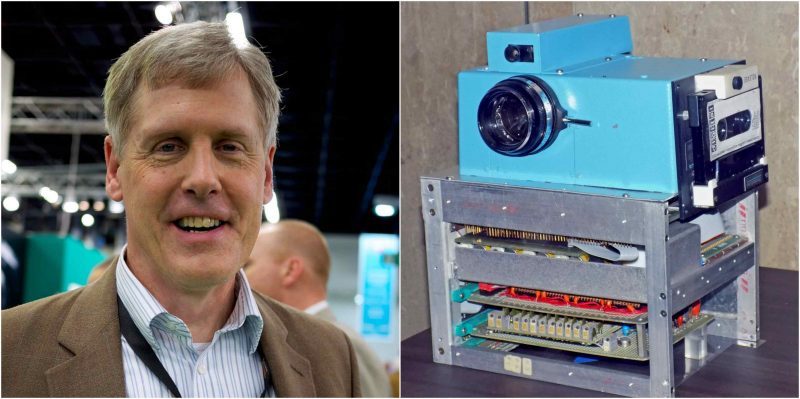
This is all thanks to engineer Steven Sasson, who invented digital photography and created the first digital camera in 1975. But then why did digital cameras become popular in the 21st century? people may ask.
According to The New York Times, Sasson started working for Eastman Kodak in 1973 and began his career with a task to figure out: if the charge-coupled device (C.C.D.) could have any practical use.

Steven Sasson, the inventor of digital photography, during an appearance at the Kodak booth at Photokina 2010. Author Aljawad. CC by 3.0
It was not a challenging project for the young engineer, since the charge-coupled device had been developed in 1969 by Willard Boyle and George E. Smith. Sasson himself said that the project was not that hard and even thought that they assigned it to him in order to keep him busy.
While working on the project, Sasson came up with the invention of the first digital camera, “as big as a toaster,” and a device to display it on.
He knew that his invention had revolutionary potential. But when Sasson presented his inventions to the executives of Eastman Kodak, their response was not what he might have expected.
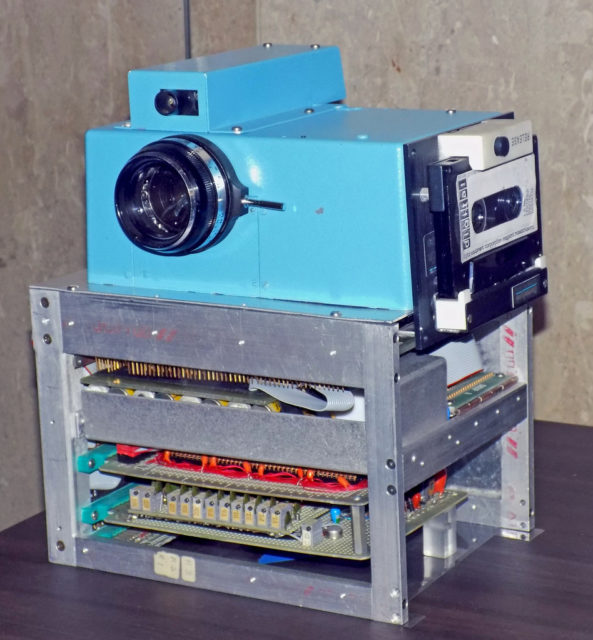
First Digital Camera Author: MrGray70 CC by 2.0
The executives did not seem as impressed as he hoped they would be. What he might not have immediately grasped was how disturbed they were by the potential threat of Sasson’s invention to the company. Eastman Kodak was a giant in the photography market in the United States, making money from everything connected with the process of photography.
Back then Kodak had a virtual monopoly on the photography market, and according to The Economist, by 1976 the company accounted for 85 percent of camera sales in the United States. When one considers these numbers, it is no wonder that Eastman Kodak’s executives were threatened by Sasson’s camera, which didn’t use film.
Nonetheless, they allowed him to continue developing digital cameras, and in 1978 the first digital camera was patented. On the other hand, reportedly Sasson’s bosses strictly forbade him to talk publicly about his invention or show the prototype he created to people outside Kodak.
About 14 years after Sasson came up with the invention of the first digital camera, he co-created the first modern digital single-lens reflex (S.L.R.) camera with his colleague Robert Hills. Just as in 1975, Eastman Kodak’s executives prioritized film sales, and the camera never saw the light of day.

The Kodak “K” logo was introduced in 1971. The version seen here – with the “Kodak” name in a more modern typeface – was used from 1987 until the logo’s discontinuation in 2006, but later used again in 2016.
The digital camera patent has helped earn billions for Kodak, according to The New York Times. But when it expired in 2007, Kodak was not prepared to compete on the market of digital technology, and five years later, what was once a household brand and the world’s biggest film company filed for bankruptcy. “The company filed for bankruptcy protection in 2012, exited legacy businesses and sold off its patents before re-emerging as a sharply smaller company in 2013,” reported the Harvard Business Review. “Once one of the most powerful companies in the world, today the company has a market capitalization of less than $1 billion.”
Sasson’s first digital camera is now on display at the Smithsonian’s National Museum of American History, and it inventor was awarded the National Medal of Technology and Innovation in 2009.
Steven Sasson
In 1974, Kodak supervisor Gareth Lloyd asked electrical engineer Steve Sasson to investigate whether charge-coupled devices could be used to create an image sensor for a camera. After a year in the laboratory, Sasson created a device that captured an image, converted it to an electronic signal, digitized the signal, and stored the image – the first digital camera.
An early adopter of digital imaging technology was the newspaper industry. In 1994, Kodak developed one of the first commercially-available digital cameras, the AP NC 2000, in cooperation with the Associated Press and Nikon. The first consumer digital camera to incorporate an LCD screen on the back was the Casio QV-10 in 1995, which retailed for around $650 and had 2MB of memory.
Today, consumers can choose from a wide array of cameras, from less than $100 to thousands of dollars. In 2008, 73% of Americans owned a digital camera and 34 million digital cameras were sold in the U.S., generating $7 billion in revenue. Virtually all of today`s digital cameras rely on the same structure that Sasson invented in 1975.
Raised in Brooklyn, Sasson attended Rensselaer Polytechnic Institute, receiving his B.S. and M.S. He joined Kodak in 1973 and remains there today. Most recently, he works with Kodak`s Intellectual Property Transactions group.
