Viral ‘Monster’ is Actually Prized Damascus Goat
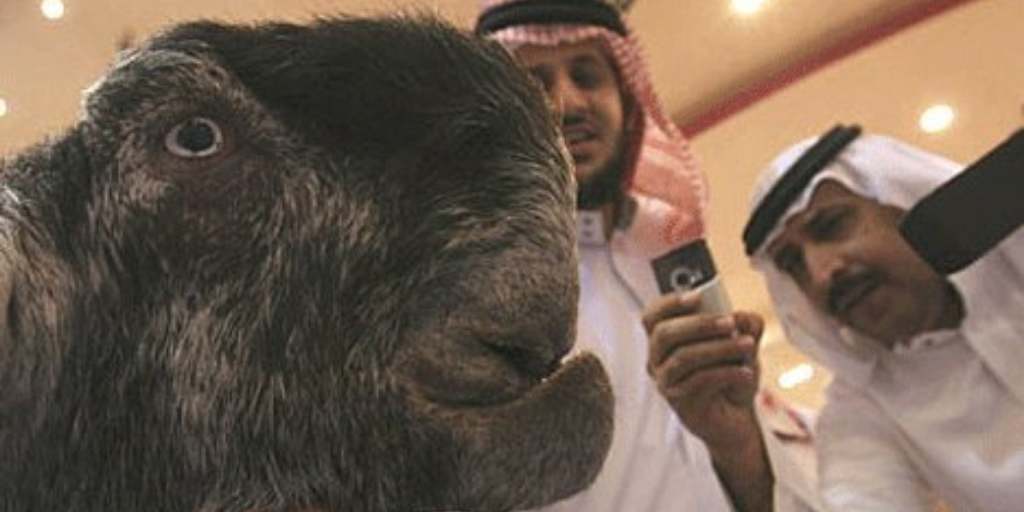
Over the last few days, Egypt has been captivated by a viral video, posted on a Facebook group for buying and selling goats in the country. The video in question features a peculiar-looking creature with a long neck, protruding forehead, and seemingly unusual underbite. Despite having been – perhaps somewhat cruelly – dubbed the ‘goat monster’ by viewers, the animal is, in fact, a Damascus goat – a prize-winning species native to Syria, Cyprus, and Lebanon, coveted for its superior quality of milk.
According to IFLScience, the now-famous goat is “likely the result of many generations of the most dramatically featured individuals being mated together”. Newspapers have mistakenly labeled the goat as ‘mutated’, not realising that his features are characteristic of the breed. Though his features are undoubtedly exaggerated when compared to the average Damascus goat, they are probably a little less extreme in real-life, as becomes apparent after a closer look at the video.
From afar, to those who have never seen a Damascus goat, the animal’s mouth appears extremely large and somewhat grotesque, apparently opened wide to produce alarming screams. However, the noises heard in the video are in fact coming from the surrounding goats, and Yours Truly is actually waiting patiently in his pen – mouth closed – observing the day’s happenings. In addition, it seems that he has been the unfortunate victim of an extremely unflattering camera angle.
Indeed, while we are used to the concept of horse and camel shows, many will be surprised to learn that goat contests are also popular in the region. In 2008, the breed hit headlines as a goat named Qahr won the title of ‘Most Beautiful Goat’ at the ‘Mazayen al-Maaz’ competition in Riyadh, Saudi Arabia.
For goat fans, this unusual Egyptian animal can be added to the goat-world’s already eclectic list of personalities. Goat lovers have previously been entranced by America’s fainting goats, known scientifically as ‘Myotonic’ goats. When they are startled, the animals will usually attempt to run from the source of panic, only to seize up and collapse moments later. These attacks, during which the goats’ limbs freeze, tend to last from five to twenty seconds, and are caused by the hereditary genetic disorder, ‘myotonia congenita’. The fainting goats were first brought to Marshall Country, Tennessee, in the 1880s, but a hundred years later they were a relatively rare occurrence.
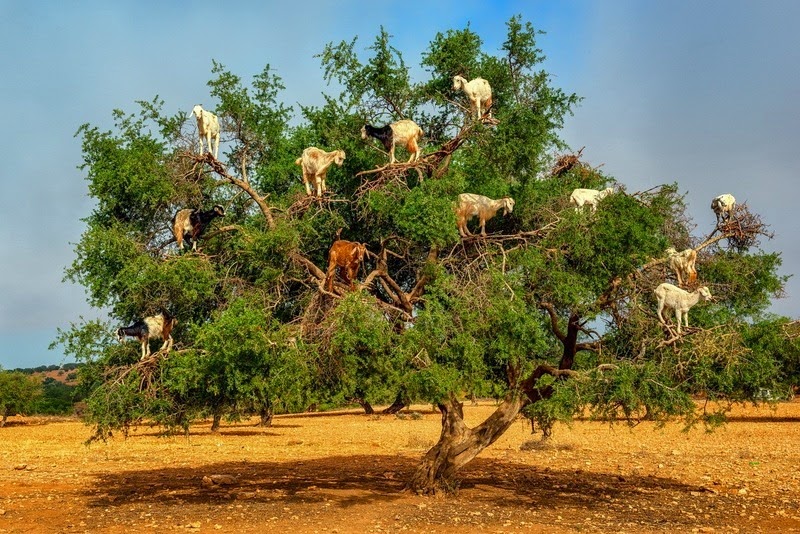
The Arab world has also produced another notable specimen of strange goat, namely the tree-climbing goats of Morocco. In the country’s south-west, goats can climb eight to ten meters up the argan trees to eat their fruit and leaves. By regurgitating and spitting out the nuts – or defecating them – it is said that they save argan harvesters an important step in preparing the popular nut, as cracking them open is the first step in making argan oil. While some consider the goats’ activity important for the life of the argan forests, others suspect that an increased goat population is stunting the growth of trees – because they keep eating them.
For some people, however, goats entered their hearts with the viral screaming goat videos. ‘Goats Yelling Like Humans’ has racked up a whopping 39 million views over the last five years, showcasing the best goats with uncannily human-like voices. The racket, however, is not particular to just one species; yelling is rather common among goats.
The reasons for such behaviour have been investigated, and include mothers and kids calling for each other as well as calling for food. Apparently, according to Dr. Jean-Marie Luginbuhl of North Carolina State University, who was interviewed by the goat enthusiasts of Slate, goats each have a “distinctive voice”, and not all sound like humans when they yell. And when it came to the viral video, a Dr. An Peischel of Tennesse State University stated, “the individuals making the noises were not all goats. There are several sheep involved.”